
Illuminating your pool area is about more than ambiance—it’s a critical safety function. The primary goal is to eliminate electrical hazards near water while providing clear, functional light for swimming and socializing. A waterproof outdoor wall light is the cornerstone of safe poolside lighting, but its installation and specifications must adhere to strict safety codes. The IP65 Waterproof Double-Head Wall Lamp is engineered for these demanding environments. This guide breaks down the essential standards from the National Electrical Code (NEC) and International Electrotechnical Commission (IEC) to ensure your lighting is both beautiful and safe.
Table of Contents
The Non-Negotiables: IP Ratings & Electrical Safety
Pool areas are classified as “wet and hazardous locations.” Your chosen outdoor wall light must meet two foundational safety requirements.
1. The Correct Ingress Protection (IP) Rating
- Poolside Walls (Non-immersion): A minimum of IP65 is required. This rating ensures the fixture is “dust-tight” and protected against low-pressure water jets from any direction—perfect for resisting splashes, rain, and routine cleaning. The featured fixture meets this standard.
- Areas Prone to Direct Spray or Immersion: For lights on columns in the splash zone or within pool walls, you need IP68 (protected against continuous immersion). Never use fixtures rated below IP54 near a pool.
- Key Takeaway: Look for the “IP” code on the specification sheet. For general pool perimeter lighting, IP65 is your benchmark.
2. Essential Electrical Protection
- Insulation Class: Opt for Class II (Double Insulated) fixtures. These have reinforced or double layers of insulating material, providing protection even if the outer casing is damaged, with no requirement for a ground wire.
- Grounding: If the fixture has exposed metal parts and is not Class II, it must be properly grounded (bonded) according to local code to prevent electrocution.
- Voltage: While not always mandatory, using a low-voltage (12V or 24V) outdoor wall light system is the safest choice, especially for DIY projects or family pools. Many fixtures, including our example, have internal drivers that safely manage standard household current.
Installation Zones: Where to Place Your Lights
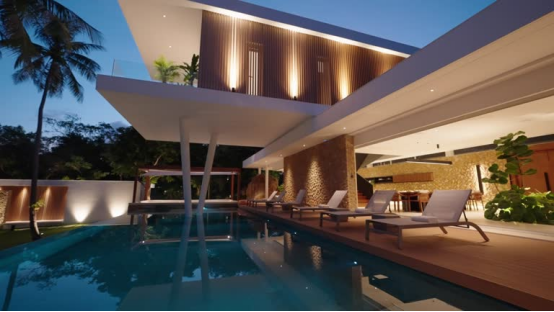
The NEC and IEC define specific zones around a pool. Where you place your outdoor sconce light is dictated by these zones.
Zone 0: Underwater
- Not applicable for standard wall lights. Requires specialized underwater fixtures.
Zone 1: The Immediate Poolside (0 to 2.5 meters / ~8 feet from the water’s edge)
- This is a high-risk area. Only fixtures rated for at least IP68 and specifically listed for “wet” or “submersion” locations should be installed here.
Zone 2: The Extended Perimeter (2.5 to 4 meters / ~8 to 13 feet from the water’s edge)
- This is the primary zone for IP65-rated wall lights, like the featured fixture. Mounting here safely illuminates the pool deck and water surface while keeping the electrical components outside the highest splash zone.
Mounting Height & Spacing
- Height: Install fixtures between 2.0 and 2.5 meters (6.5 to 8 feet) above the deck. This prevents accidental contact and reduces glare for swimmers.
- Spacing: Space lights evenly to avoid dark spots. A good rule is to space them 1.5 to 2 times the mounting height apart. For example, lights at 2.2m high should be spaced 3.3 to 4.4 meters apart.
Brightness & Light Quality: Clarity Without Glare
Proper illumination prevents accidents and enhances usability.
1. Lumen Output & Foot-Candle Requirements
- Pool Water Surface: Aim for a minimum of 200 lux (~20 foot-candles). This allows clear visibility into the water.
- Pool Deck: Maintain at least 150 lux (~15 foot-candles) for safe walking on wet surfaces.
- Seating Areas: A softer 100 lux (~10 foot-candles) is sufficient for relaxation.
- A fixture like our 1200-lumen example, with its focused beam, can easily achieve these targets when correctly positioned.
2. Optimal Color Temperature
- Choose 4000K (Neutral White) light. It closely mimics daylight, providing excellent color rendering to distinguish objects (like a pool toy vs. a shadow) without the harsh, sterile feel of 5000K+ or the dim, yellowed effect of 3000K.
3. Glare Control
- Select fixtures with deep shrouds or recessed lenses that cut off light at eye level. The light should be directed downward onto the deck and water, not horizontally into swimmers’ eyes. Adjustable heads, like those on the double-head lamp, allow for precise aiming.
Professional Installation Checklist
Safety is in the details. Follow these best practices:
- Use Approved Conduit & Boxes: All wiring must be in weatherproof (liquid-tight) conduit leading to listed outdoor junction boxes.
- Seal Every Penetration: Use silicone sealant around the fixture’s base and any conduit entries into junction boxes to create a watertight barrier.
- Secure Mounting: Attach fixtures directly to sturdy structural surfaces (brick, concrete, solid wood) using corrosion-resistant stainless steel hardware.
- Final Test: Before regular use, conduct a GFCI (Ground Fault Circuit Interrupter) test. All pool area circuits must be protected by a GFCI, which will trip in milliseconds if a fault is detected. Spray the installed light with a hose to simulate rain and check for proper operation.
FAQs: Your Pool Lighting Questions Answered
Q: My pool is irregularly shaped. How do I space the lights?
A: Focus on illuminating the entire deck perimeter evenly. Place lights at all key corners and along long stretches, maintaining the height-to-spacing ratio. Use adjustable fixtures to direct light where it’s needed most.
Q: Can I use smart/color-changing outdoor wall lights by the pool?
A: For primary safety lighting, stick with fixed, bright white light. Smart RGB lights can be used for secondary accent lighting in seating areas further from the water, but they must still meet the required IP rating for their location.
Q: How do I maintain my poolside lights?
A: Periodically check seals for cracks, wipe lenses clean of dirt and chemical residue (especially in saltwater pools), and ensure all mounting hardware remains tight.
Light Your Pool with Confidence
A well-lit pool is a safe and enjoyable pool. By choosing an IP65 waterproof outdoor wall light designed for wet locations, installing it in the correct zone, and following electrical code, you create a space that’s secure for nighttime use.
Illuminate your poolside safely. Explore our code-compliant collection of waterproof outdoor wall lights, designed for durability and peace of mind.