
Choosing an outdoor wall light isn’t just about style and brightness—it’s a critical decision of scale. A fixture that’s too small looks lost and insignificant; one that’s too large overwhelms your home’s facade. The key is proportion. The Double-Head Large Outdoor Wall Light (35x25x20cm) is a masterclass in balanced design. Let’s decode the professional formulas architects and designers use to match outdoor wall lighting perfectly to any building.
Table of Contents
The Golden Rule: Scale, Don’t Dominate
The goal is for your outdoor wall lamp to complement your architecture, not compete with it. This is achieved by creating a visual relationship between the fixture’s dimensions and key architectural elements: door/opening height, wall area, and overall building height. The professional consensus is that a deviation beyond 10% from these proportional guidelines creates noticeable visual imbalance.
Formula 1: The Door/Opening Rule (Most Critical)
Fixture Height = (Door Height) x (1/4 to 1/3)
This is the most important rule for fixtures beside entryways, garage doors, or large windows. The light should frame the opening, not disappear beside it or overpower it.
- Standard Entry Door (80-84″ / 203-213cm): Target fixture height = 20-28″. A substantial single or double-head outdoor sconce light in this range creates a dignified presence.
- Tall/Grand Entry (96-120″ / 244-305cm): Target fixture height = 24-40″. This calls for a true large outdoor wall light, often with multiple heads or an elongated design to hold visual weight.
- Our Example Fixture: At ~60cm (23.6″) tall including its bracket, it perfectly complements a door in the 92-118″ (234-300cm) range, making it ideal for many suburban and rural homes.
Formula 2: The Wall Area Rule (For Blank Walls)
Fixture Face Area = (Visible Wall Area) x (5% to 8%)
Use this when placing a light on a long, unbroken wall (e.g., a garage side, a garden wall). Calculate the clear rectangle of wall where the light will be the focus.
- Small Garden Wall (e.g., 3’x6′ / 0.9×1.8m = 10.8 sq ft): Target fixture area = 0.54-0.86 sq ft. A compact, single-head outdoor wall mounted light works well.
- Large Garage or Facade Wall (e.g., 8’x10′ / 2.4x3m = 80 sq ft): Target fixture area = 4-6.4 sq ft. This requires a bold, multi-head fixture or a grouped installation.
- Our Example Fixture: With a face area of approximately 0.94 sq ft (0.087 sq m), it is proportionally correct for a focal wall section of about 12-19 sq ft—perfect for accenting a specific architectural element or a cozy seating nook.
Formula 3: The Building Height Rule (A Reality Check)
Fixture Height = (Story Height) x (1/8 to 1/6)
This formula ensures the light feels appropriate to the overall vertical scale of your home, especially for multi-story applications.
- Single-Story Home (e.g., 8′ / 2.4m eave height): Target fixture height = 12-16″. A medium-sized fixture avoids looking top-heavy.
- Two-Story Home (e.g., 16′ / 4.9m to the second floor): Target fixture height = 24-32″. You can confidently choose a larger, statement outdoor wall light fixture.
- Our Example Fixture: At 23.6″ tall, it is ideally scaled for a story height of 12.5-14 feet, which aligns with many one-and-a-half or two-story residential designs.
Putting It All Together: A Case Study
Let’s apply the formulas to see where the featured Double-Head Wall Light shines:
- Beside a 7-foot (213cm) Garage Door: Formula 1 suggests a 21-28″ fixture. At 23.6″, it’s perfect.
- On a 4’x5′ (1.2×1.5m) Accent Wall: Formula 2 suggests a 1.2-1.9 sq ft fixture. At 0.94 sq ft, it’s visually substantial without crowding.
- On a Home with ~14-foot (4.3m) Walls: Formula 3 suggests a 21-28″ fixture. Again, it fits seamlessly.
Pro Tips for Flawless Execution
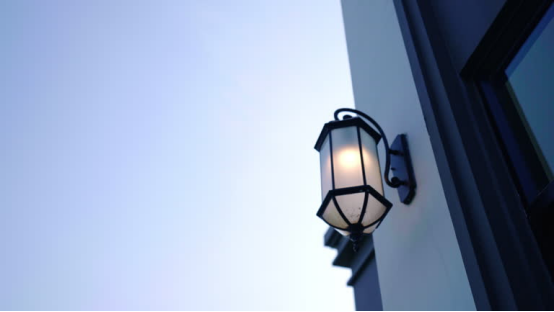
- Spacing Multiple Lights: If installing several large fixtures in a row, space them at a distance of 1.5 to 2 times the fixture’s height.
- Style Informs Proportion: Modern homes can handle sleeker, vertically oriented lights. Traditional homes often suit fixtures with more volume and width. The featured light’s classic dual-head design offers width that balances its height, making it versatile.
- Common Mistakes to Avoid: Don’t let a tiny light flank a massive door. Don’t place a huge lantern on a short wall. Always use the formulas as your first filter.
Conclusion: Confidence Through Calculation
Selecting the right outdoor wall light size removes the guesswork and ensures a polished, professional result. By using these three simple proportional formulas, you can choose a fixture that enhances your home’s architecture with certainty.
Ready to find your perfectly proportioned light? Explore our curated collection of large-scale outdoor wall lights, with dimensions clearly listed for easy selection.