
Front-door lighting is more than just brightness—it’s about coverage, safety, and convenience. Many homeowners install a single outdoor wall light only to discover it illuminates just a small portion of the entryway. Keyholes remain in shadow, visitors are hard to identify, and steps, gravel, or obstacles become potential hazards at night. Especially during rainy or overcast conditions, inadequate lighting increases the risk of accidents.
A dual-head outdoor wall light solves these problems by offering multi-directional illumination and a broader coverage area. This guide explains why wide-coverage lighting is essential, how dual-head fixtures outperform single-head lights, and what features to prioritize. It also recommends a waterproof dual-head outdoor wall light designed specifically for front entrances: Check it here.
Table of Contents
Why Wide-Coverage Lighting Matters at the Front Door
The entryway is the first point of contact with your home, so lighting should be bright and evenly distributed. Without wide coverage, homeowners typically face three issues:
- Inconvenience: A single-head wall light usually covers only 1–2 m². Keyholes, door locks, and keypad panels often fall outside the illuminated area, forcing you to fumble with a flashlight, especially when carrying groceries or bags.
- Safety risks: Dim lighting increases the likelihood of trips or falls over steps, gravel, or garden edges. Narrow-beam lights also make it difficult to identify visitors, leaving your home vulnerable to intruders.
- Visual disconnection: A single bright spot surrounded by dark areas creates a stark contrast, disrupting the aesthetic flow between the yard, pathway, and entrance. Eyes have to constantly adjust, reducing comfort and safety.
Optimal front-door lighting should cover: the door itself, the ground up to 1–2 meters in front, and adjacent side areas—forming a seamless, shadow-free illumination band that improves both usability and security.
How Dual-Head Wall Lights Provide Superior Coverage
Dual-head outdoor wall lights outperform single-head fixtures in three critical ways: coverage area, uniformity, and adaptability.
1. Larger Coverage Area
Single-head lights often cast a narrow fan-shaped beam (90° downward or 120° forward), covering only a small portion of the entryway. Dual-head designs solve this problem:
- Independent adjustment: One head can illuminate the door and keyhole, while the other lights the ground, steps, or surrounding area.
- Cumulative coverage: A single-head may cover 1.5 m², but dual-head lights can illuminate 2.5–3.5 m² or more—up to 50% wider than equivalent single-head fixtures.
- Practical example: The recommended IP65 waterproof dual-head wall light allows 0–90° independent adjustment, covering most front-door layouts and eliminating blind spots.
2. More Even Illumination
Single-head lights often create hotspots directly under the fixture while leaving peripheral areas dim. Dual-head lights reduce this issue:
- Dispersed light: Heads are spaced 15–25 cm apart, projecting overlapping beams for uniform illumination.
- Adjustable brightness: Some dual-head lights allow independent dimming, highlighting key areas like keyholes while keeping surrounding light soft.
3. Adaptable to Various Doorway Layouts
Front entrances differ in door types, width, steps, and porches:
- Single doors: One head aimed downward, one outward for pathway coverage.
- Double doors: Each head targets its respective door side.
- Steps or porches: Downward light for steps, horizontal or upward light for porch areas.
- Narrow or wide doors: Angles can be adjusted to maximize coverage without excessive brightness.
Dual-head designs provide universal adaptability that single-head lights cannot match.
Choosing the Right Dual-Head Outdoor Wall Light
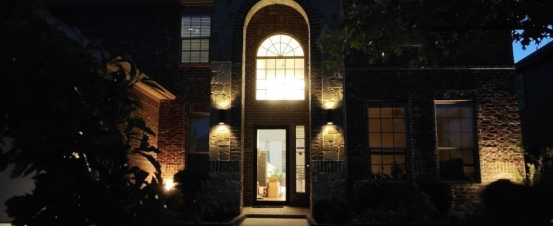
When selecting a dual-head fixture, consider brightness, waterproofing, and smart control features:
1. Brightness
- Wattage: 15–30W LED (7.5–15W per head) provides adequate illumination without glare.
- Lumens: 1500–3000 lm (equivalent to 200–400W incandescent) lights 3–5 m² effectively.
- Color temperature: Warm white 3000–4000K for comfortable, natural visibility.
- Example: The recommended fixture uses 24W LED (12W per head) at 3500K, ideal for most front-door setups.
2. Waterproofing
- IP65 rating ensures dust-tight protection and water resistance from any angle.
- Details to check: Silicone gaskets at seams, sealed wiring housing, and waterproof joint designs.
- Durability: Aluminum alloy construction resists corrosion and UV damage, lasting 5–8 years outdoors.
3. Smart Controls
- Motion sensor: Activates light when someone approaches (10–15 ft range, 120° angle), turning off after 30–60 seconds.
- Dusk-to-dawn sensor: Automatically switches lights based on ambient light levels.
- Combination mode: Ensures hands-free, energy-efficient operation.
- Example: The recommended model integrates motion + photocell, providing automatic nighttime lighting without manual operation.
Installation and Adjustment Tips
Even the best dual-head fixture underperforms if installed incorrectly:
1. Mounting Height
- Recommended 1.8–2.2 m (6–7 ft) from the ground; higher if steps exist.
- Placement: For single doors, mount on the side opposite the door swing; for double doors, mount symmetrically on both door posts.
2. Beam Angle Adjustment
- Narrow doors: Both heads angled downward at ~45° for keyhole and pathway coverage.
- Wide doors with steps: One head downward for steps, one horizontal for pathway.
- Porches or overhangs: One head upward to enhance ambiance, one downward for visibility.
3. Style Coordination
- Modern: Black or white aluminum, clean lines.
- Traditional: Brass or bronze finishes, vintage textures.
- Industrial: Matte black steel, exposed bulbs.
Proper style matching ensures the fixture integrates seamlessly with the home’s aesthetic.
Recommended Product: IP65 Waterproof Dual-Head Outdoor Wall Light
This dual-head fixture is ideal for wide coverage, safety, and convenience:
- Coverage: 0–90° adjustable heads, lighting up to 3.5 m².
- Durability: IP65 waterproof, aluminum alloy body, silicone-sealed joints.
- Smart functions: Motion + dusk-to-dawn control for hands-free operation.
- Aesthetics: Black and white options for modern or minimal styles.
Explore more details here: IP65 Dual-Head Outdoor Wall Light
Conclusion
Front-door lighting should not be limited to a single bright spot. Dual-head outdoor wall lights offer:
- Broader coverage
- Even illumination
- Flexibility for different entrance types
- Integrated smart controls
- Reliable outdoor durability
When installed at the correct height, adjusted for angles, and paired with suitable wattage and color temperature, these fixtures enhance safety, convenience, and aesthetic appeal.
Upgrade to a dual-head outdoor wall light, and ensure your home’s entrance is bright, welcoming, and secure, day or night.