There’s a special kind of frustration that comes with an outdoor wall light that flickers, dims prematurely, or needs a bulb replacement every few months. What’s sold as a convenience becomes a recurring chore and an unexpected expense. The culprit is rarely the fixture itself, but a mismatch between its design and the demanding reality of outdoor use. This guide explains why most fixtures fail early and how a thoughtfully engineered outdoor wall light, built around high-quality LED technology and proper thermal management, can provide reliable, maintenance-free illumination for years.
Table of Contents
The 4 Hidden Killers of Outdoor Light Lifespan
Understanding what shortens a light’s life is the first step to choosing a longer-lasting one. The main culprits are often interrelated:
- Subpar LED Chips: At the heart of every LED light is its semiconductor chip. Low-grade chips use inferior materials, leading to inefficient light output (lumens per watt), poor color rendering, and rapid “lumen depreciation” (the light gets dimmer over time). They may be rated for only 10,000-15,000 hours, but their performance degrades long before they fully burn out.
- Inadequate Heat Management (The #1 Enemy): LEDs produce light efficiently, but they still generate heat, especially at the junction of the chip. If this heat isn’t dissipated, it dramatically accelerates the degradation of the LED’s internal components. A sealed, non-ventilated fixture is a recipe for a short lifespan.
- Environmental Stress: An outdoor wall light faces rain, humidity, UV radiation, and temperature swings. Moisture ingress can corrode electrical connections and drivers. UV rays can degrade plastics and finishes. These factors don’t just affect the housing; they compromise the entire electrical system supporting the LED.
- Component Incompatibility: Using an incorrect or low-quality bulb in a compatible socket, or a poorly integrated LED module, creates system stress. An under-powered driver or an over-driven LED chip will fail quickly.
A durable outdoor wall light is designed to combat all four of these threats simultaneously.
The Anatomy of a Long-Lasting Outdoor Wall Light: More Than Just a Bulb
True longevity comes from a holistic design where every component supports the other.
1. The Engine: Premium LED Modules
The core of any long-lasting fixture is its light source. Look for these indicators of quality:
- High Lumen Maintenance: Premium LEDs are rated to maintain 70% or more of their initial light output (often labeled L70) for 50,000 hours or longer. This means after a decade of typical use, the light will still be bright.
- High Color Rendering Index (CRI): A CRI of 80+ indicates better color accuracy and light quality, which is often correlated with better semiconductor materials and manufacturing.
- Integrated vs. Replaceable: High-quality fixtures often use integrated, sealed LED modules rather than standard bulb sockets. This allows for better thermal and environmental integration. For socketed fixtures, the specification should clearly support long-life, outdoor-rated LED bulbs.
2. The Cooling System: Intelligent Thermal Management
Heat dissipation is non-negotiable. A good outdoor wall light will have design features dedicated to this:
- Heat Sink Design: Look for fixtures with visible fins or a housing made from a material with high thermal conductivity, like die-cast aluminum. Aluminum acts as a natural heat sink, pulling warmth away from the LED chip.
- Ventilation Strategy: Some designs incorporate subtle ventilation paths that allow convective airflow without letting in water. A “breathable” yet sealed design is the goal.
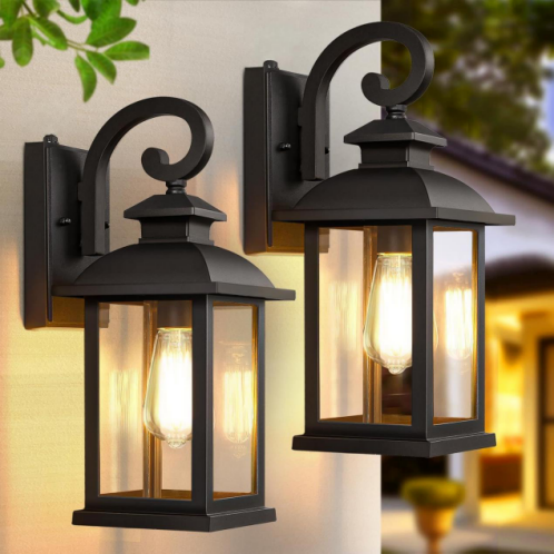
- Distributed Design: A fixture with two or more separate light sources (like a dual-head outdoor wall light) naturally spreads the thermal load, preventing a single hot spot.
3. The Armor: Environmental Sealing and Durable Materials
- IP Rating: A rating of IP65 is excellent for most outdoor applications. The “6” means it’s dust-tight, and the “5” means it can withstand low-pressure water jets from any direction (heavy rain, wind-driven spray).
- Material Quality: Aluminum and stainless-steel housings resist corrosion. High-quality polycarbonate for lenses is impact-resistant and UV-stabilized to prevent yellowing.
- Sealed Electrical Compartments: Gaskets and seals at all joints—between the lens and housing, and at the mounting plate—are crucial for keeping moisture away from the driver and wiring.
Maximizing Your Outdoor Wall Light’s Lifespan: User Tips
Even the best fixture benefits from smart installation and care:
- Install for Airflow: Mount the fixture so it isn’t completely flush against siding if possible; a small air gap behind it aids in cooling. Avoid enclosing it in a tight niche.
- Choose the Right Location: If possible, avoid placing the light where it will get direct, intense afternoon sun, as this adds to the thermal load.
- Gentle Cleaning: Periodically wipe the fixture with a soft, damp cloth to remove dust and dirt that can trap heat and degrade finishes. Avoid harsh chemicals.
- Use Compatible Components: If your fixture uses replaceable bulbs, invest in high-quality, name-brand LEDs designed for enclosed or damp locations. Don’t exceed the maximum wattage listed.
Common Myths That Shorten Light Life
- Myth: “All LEDs Last 50,000 Hours.” This is a theoretical rating under ideal lab conditions. Real-world lifespan depends entirely on the fixture’s ability to manage heat and environmental stress.
- Myth: “A Sealed Fixture is Always Better.” A completely sealed fixture with no heat dissipation strategy will cook its LEDs. The balance between sealing out water and managing heat is key.
- Myth: “The Housing is the Most Important Part.” While a sturdy housing is vital, the internal components—the LED chip and the driver (its power supply)—are the true determinants of longevity. A beautiful fixture with a cheap driver will fail quickly.
- Myth: “Brighter (More Watts) is Always Better.” Over-driving an LED for maximum brightness generates excessive heat and shortens its life. A quality fixture provides ample light efficiently without being pushed to its limit.
Conclusion: Invest in Light, Not in Replacement
Choosing an outdoor wall light is an investment in safety, security, and ambiance. Opting for a fixture engineered for longevity transforms it from a disposable item into a permanent, reliable feature of your home. By prioritizing products built with premium LEDs, intelligent thermal design, and robust environmental sealing, you buy years of maintenance-free service.
The upfront cost is balanced by the elimination of frequent bulb changes, ladder time, and the frustration of premature failure. For a fixture that embodies this principle of durable design, explore our selection of long-lasting, dual-head outdoor wall lights with integrated premium LEDs.